 Binance
 combines spot and futures markets with Earn products that have distinct funding and redemption rules
Binance is a centralized crypto exchange with spot trading, quoted conversions, leveraged markets and Earn products that reward subscribed assets. Spot purchases create an asset balance; futures create a contract position backed by margin. Earn subscriptions have their own redemption conditions, which affect access to funds. Supported interfaces can automatically redeem eligible Flexible balances for trading. Access varies with verification, location and product eligibility. The choice depends on whether the intended outcome is an asset exchange, leveraged exposure or rewards on holdings.
Last updated
Key takeaway: A Flexible Earn balance can fund a spot order only when the relevant assets meet the product's redemption conditions.
Spot trading, quoted conversions and leveraged exposure
Spot and Convert exchange assets, Margin adds borrowing and Futures provides contract exposure. These functions differ in price formation, funding requirements and the obligations that remain after execution.
Spot and Convert
Spot trading matches buy and sell orders through an order book. A market order takes available liquidity and can execute at several prices. A limit order sets a price boundary, although reaching that price does not guarantee a complete fill. Convert's Instant mode supplies a quote that expires after a short acceptance window. Convert also supports recurring purchases and limit conversions. Its limit mode depends on its quoted price and available liquidity, so touching the selected target does not guarantee execution. Eligible users can choose to keep Convert limit-order funds in Flexible Products while waiting. For this option, subscription failure prevents order creation and redemption failure prevents execution.
Margin and Futures
Margin loans
Margin Trading permits borrowing against holdings for leveraged spot transactions. The borrowed asset determines the repayment obligation, and interest adds to the outstanding debt. Cross Margin and Isolated Margin organize collateral differently: cross positions share collateral within the applicable margin account, while isolated positions use their allocated collateral. Both remain subject to liquidation when their collateral no longer meets the applicable requirements. Borrowing also depends on available lending inventory and the account's collateral-based limit.
Futures positions
Futures Trading establishes contract exposure to an underlying asset. Perpetual contracts have no scheduled expiry and use funding payments to help track the underlying market. Delivery contracts have an expiry and settlement terms. Margin requirements govern how much exposure the account can support. Liquidation uses Mark Price, a valuation based on market inputs, rather than simply the latest executed trade price. The applicable contract and account mode determine collateral treatment.
Earn subscriptions and redemption conditions
Earn subscriptions generate rewards under product-specific terms, so redemption availability and the settlement asset matter alongside the displayed annual percentage rate (APR).
Flexible and Locked Products
Simple Earn Flexible Products support redemption without waiting for a locked term to end. Successful processing normally returns assets to the Spot Wallet, subject to product limits and liquidity. Their yield includes income from lending through Margin and Loan services. Borrower defaults can reduce returns, and extreme market events can cause partial or total loss of subscribed assets. A Flexible balance pledged to Flexible Loans requires loan repayment and collateral release before redemption. Displayed APR describes crypto rewards; changes in the asset's market value affect its fiat value separately.
Locked Products commit assets for a selected term and redemption date. Where early redemption is available, it forfeits accrued rewards and deducts previously distributed rewards from the returned principal. Some campaign reward products exclude early redemption. At maturity, redemption settings can return assets to Spot or place them in the corresponding Flexible product. A fixed term does not necessarily mean a fixed APR, and early redemption can involve processing delays.
Structured settlement and futures collateral
Dual Investment can settle in the deposit asset or its target asset, depending on the fixing price (a settlement-date market average) and selected target price. Buy Low converts the subscription and rewards at the target price when the fixing price is at or below it. Sell High converts them at the target price when the fixing price is at or above it. Subscription terms fix the target price, settlement date and APR, and funds remain unavailable until settlement.
Eligible master accounts can convert USDT Flexible holdings into LDUSDT, a reward-bearing margin asset for USDⓈ-M Futures in Multi-Assets Mode or eligible Portfolio Margin accounts. Real-Time APR accumulates in its value, while futures liquidation can put that collateral at risk. Bonus Tiered APR does not apply, and balances pledged to Flexible Loans cannot supply the conversion. LDUSDT cannot be withdrawn externally. Swapping it back returns USDT to Flexible holdings, subject to margin requirements and available liquidity.
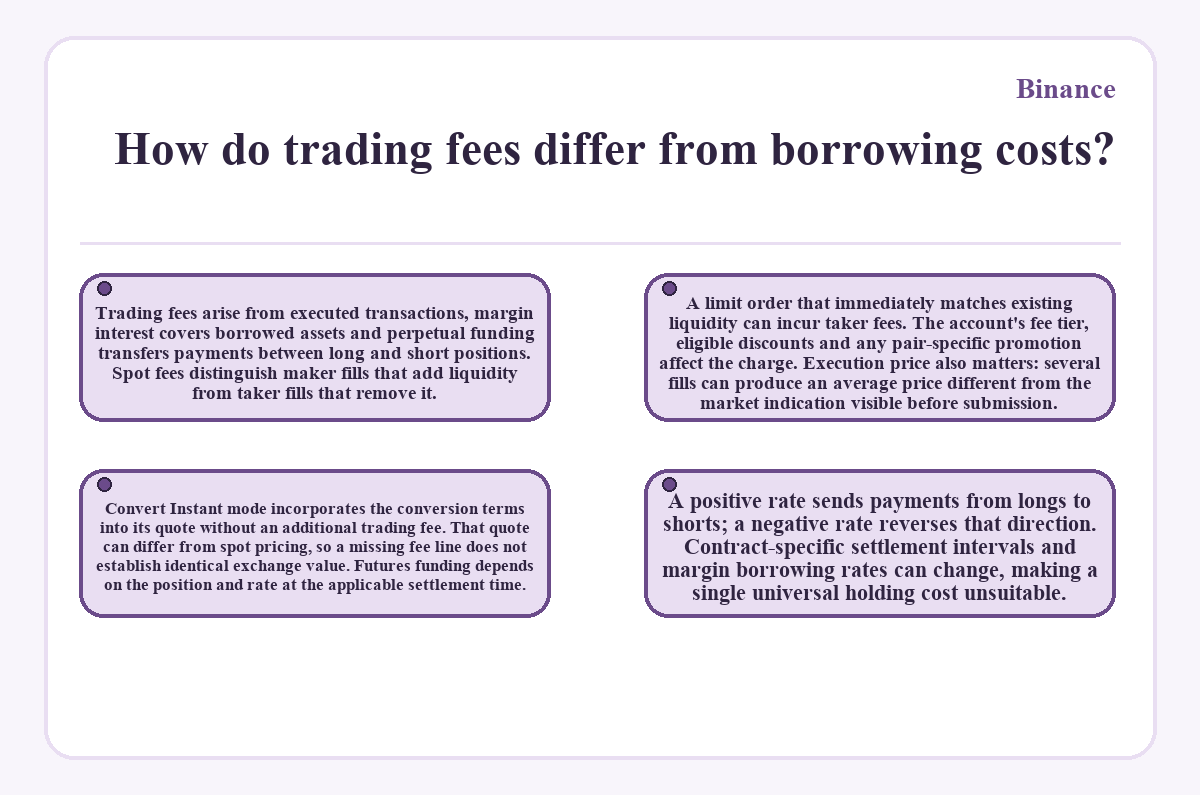
How do trading fees differ from borrowing costs?
Trading fees arise from executed transactions, margin interest covers borrowed assets and perpetual funding transfers payments between long and short positions. Spot fees distinguish maker fills that add liquidity from taker fills that remove it. A limit order that immediately matches existing liquidity can incur taker fees. The account's fee tier, eligible discounts and any pair-specific promotion affect the charge. Execution price also matters: several fills can produce an average price different from the market indication visible before submission.
Convert Instant mode incorporates the conversion terms into its quote without an additional trading fee. That quote can differ from spot pricing, so a missing fee line does not establish identical exchange value. Futures funding depends on the position and rate at the applicable settlement time. A positive rate sends payments from longs to shorts; a negative rate reverses that direction. Contract-specific settlement intervals and margin borrowing rates can change, making a single universal holding cost unsuitable.
A Flexible Earn balance funding a spot purchase
An existing Simple Earn Flexible subscription can supply a spot purchase when the selected assets are redeemable. The trade needs a supported pair and sufficient usable funds. The Binance app supports Earn funding from version 2.96.1 onward, subject to feature availability. An interface without that option can use Spot funds after manual redemption, subject to the same product conditions. Existing Spot and Funding balances take priority when the app uses multiple funding sources.
| Stage | Account, balance or order detail | Trading effect | Condition that controls progress |
|---|---|---|---|
| Confirm market access | The account can access the selected spot pair. | The intended market is available. | Verification and regional eligibility apply. |
| Identify usable funds | Available balances include eligible Flexible holdings. | The order has a potential funding source. | Flexible Loan collateral needs repayment and release. |
| Select the funding method | Choose Earn - Flexible Assets or Spot funds after manual redemption. | The order can draw from the selected source. | Automatic Earn funding in this app flow requires version 2.96.1 or later. |
| Specify the order | Set the supported pair, amount and order type. | The request defines the intended exchange. | Orders that violate the pair's applicable quantity or order-value filters are rejected. |
| Place and fund the order | Automatic Earn funding redeems the needed portion into Spot; manual redemption has already supplied Spot funds. | The redeemed amount becomes trading funds. | Redemption quotas and liquidity can restrict processing. |
| Match available liquidity | The engine can execute an accepted order when available liquidity meets its price conditions. | The order can remain open or fill partially. | Acceptance does not establish a complete fill. |
| Review the executed trade | Trade History records filled quantities, execution prices and fees. | Filled quantities and fees describe what the completed trade exchanged. | Only executed quantities count as completed trades. |
Manual redemption cannot bypass a product's quota or collateral restriction. If a spot limit order rests without filling, the redeemed amount has already left Earn and no longer accrues its rewards.
Funding methods and external transfers
Account funding can involve a card purchase, an available bank-transfer service, a P2P trade or a supported crypto deposit. Their eligibility and processing conditions differ.
Card purchases depend on the supported currency, payment provider and card issuer, with the quoted amount and charges defining the purchase. P2P trading exchanges assets with another user through an agreed payment method. Escrow holds the crypto during the transaction, while the fiat payment uses that separate payment channel. A screenshot or payment notification cannot establish actual receipt of money. Binance Pay provides another function: sending supported crypto payments, including eligible Flexible assets.
Crypto deposits require support for both the asset and its network; matching an address format alone cannot establish compatibility. Exchange withdrawals use the selected network and available withdrawal balance. Earn redemption returns assets within the exchange and has no blockchain destination. Network charges and withdrawal limits apply separately from trading costs.
What does exchange custody mean for security?
Exchange custody means Binance controls the private keys for assets held in its exchange accounts, so access depends on the platform's systems and account controls. An internal wallet label identifies a product balance, not a separate key that the account holder controls. Self-custody changes that relationship by placing key management with the wallet holder.
Account protections address specific access risks. Two-factor authentication adds a verification requirement, while API permissions limit what connected software can do. A key that permits trading can authorize orders even when withdrawals are disabled.
Proof of reserves allows users to verify inclusion in covered balance snapshots through cryptographic records. The snapshot's date and asset coverage define what that evidence addresses. A proof-of-reserves snapshot does not account for every off-chain liability. It therefore cannot establish the exchange's complete financial position or promise uninterrupted access to assets.
Binance: reader questions
Which API permissions does a spot-trading bot need?
A spot-trading bot needs trading permission, while reporting software can use account-data access without order permission. Withdrawal permission is separate and unnecessary for placing spot orders. Limit each key to the functions that the software needs and protect both the key and secret as credentials that authorize account access.
Where can I export records of executed spot trades?
Executed spot trades can be exported from Spot Trade History. Order History also includes submissions that never filled, so it does not describe the same activity. A partially filled order produces records for its executed portion. Separate product histories cover Margin, Futures and Earn activity beyond a spot-only export.
Does closing a margin trade automatically repay its loan?
Closing a margin trade does not automatically settle its loan in every order mode. Auto Repay uses received assets to repay liabilities denominated in that asset; Normal mode leaves repayment separate. Interest repayment takes priority over principal. Insufficient funds can leave debt outstanding, so the remaining liability determines whether repayment has completed.
What happens to a Locked subscription when Auto-Subscribe is enabled?
Eligible Locked subscriptions can renew into a new term of the same duration when Auto-Subscribe is enabled. Renewal uses the original principal, while rewards go to the Spot Wallet. If the product's quota prevents renewal, the principal moves to the corresponding Flexible product. Auto-Subscribe applies only to selected Locked Products.
How are Simple Earn Flexible rewards credited to my account?
Real-Time APR rewards accumulate directly in the Flexible product balance in the Earn Wallet. Eligible Bonus Tiered APR rewards go to the Spot Wallet, starting the day after their accrual begins. The balances can therefore change at different times, and a growing Earn balance does not imply a matching Spot credit.
Can sub-accounts receive Bonus Tiered APR rewards from Simple Earn?
Sub-accounts do not receive Bonus Tiered APR rewards from Simple Earn Flexible Products. They can receive Real-Time APR rewards and eligible Flexible airdrops. Subscription quotas can differ between master accounts and sub-accounts, so a master's available subscription capacity does not establish the capacity available to a sub-account.